Goosechase vs. PlayTours: Which Is Better for Running Engaging Experiences?
Choosing between Goosechase and PlayTours? Both platforms let you build scavenger-hunt-style experiences, but they're built with different audiences and outcomes in mind. This breakdown covers the real differences so you can make a confident decision.
TL;DR
Choose Goosechase if you want a proven, polished experience platform with 15+ years of track record, an AI Mission generator, 250+ ready-to-go templates, a live activity feed, built-in engagement reporting, QR code joining, and purpose-built plans for K-12 education, nonprofits, and organizations of all sizes. Goosechase is the stronger fit when engagement quality, reliability, and repeatable programming matter most.
Choose PlayTours if you're building a one-off self-guided walking tour or puzzle adventure where participants follow a defined route and unlock each next stop, and the experience doesn't need to scale, repeat year after year, or carry the reliability of a platform with a longer track record.
Quick Comparison Table
| Goosechase | PlayTours | |
|---|---|---|
| Best for | Organizations, schools, nonprofits, HR, educators, facilitators, tourism | One-off self-guided walking tours and puzzle-route experiences |
| Years in market | 15+ years | ~5 years |
| Templates library | 250+ ready-to-go templates | No templates |
| Free plan | Yes (up to 3 participants; 5 teams for K-12) | Yes (up to 2 teams) |
| Live activity feed | Yes | No |
| K-12 dedicated plan | Yes | No |
| SSO | Yes | No |
| Custom terms and conditions | Yes | No |
| Pricing model | Subscription plans + single event options | Subscriptions with one-off pricing for large events available upon request |
| Browser Based Play | Yes | Yes |
Who Each Product Is Best For
Goosechase is the stronger fit if you're:
- Building experiences where participation rate is a primary success metric
- Running team events, orientations, fundraisers, training programs, customer activations, or year-round community campaigns
- Working in tourism (parks, ski resorts, museums, attractions) and want visitors to engage interactively, share photos and videos, and create user-generated content as they explore
- Looking for a platform with a proven track record at scale, with 15+ years in market, thousands of customers, and over 1 million Experiences created
- Creating experiences that benefit from progressive disclosure, with gated Missions that unlock as participants complete earlier challenges
- Working in a school, nonprofit, or enterprise that needs dedicated K-12 plans, education-grade privacy, SSO, or custom terms and conditions
- Wanting to launch quickly with 250+ ready-to-go templates and an AI Mission generator that creates ready-to-use Missions
- Running multiple events per year and want pricing flexibility (subscription or single-Experience)
PlayTours may work for you if you're:
- Building a one-off self-guided walking tour or puzzle adventure where participants follow a defined route and unlock each stop by solving the previous one
- Designing escape-room-style experiences that depend on embedded external content (Google Docs, virtual tours, crossword puzzles) and hint mechanics
- Comfortable building from scratch without templates
- Comfortable with a newer platform (founded in 2021, ~6,000 games run to date) that's still scaling
- Running occasional events with predictable, modest device counts that fit cleanly into one of their monthly tiers
Deep Dive by Decision Factors
Track Record and Reliability
If you're choosing a platform you'll trust with a high-stakes event, your annual fundraiser, a district-wide school program, a corporate all-hands, the platform's track record matters as much as its feature list.
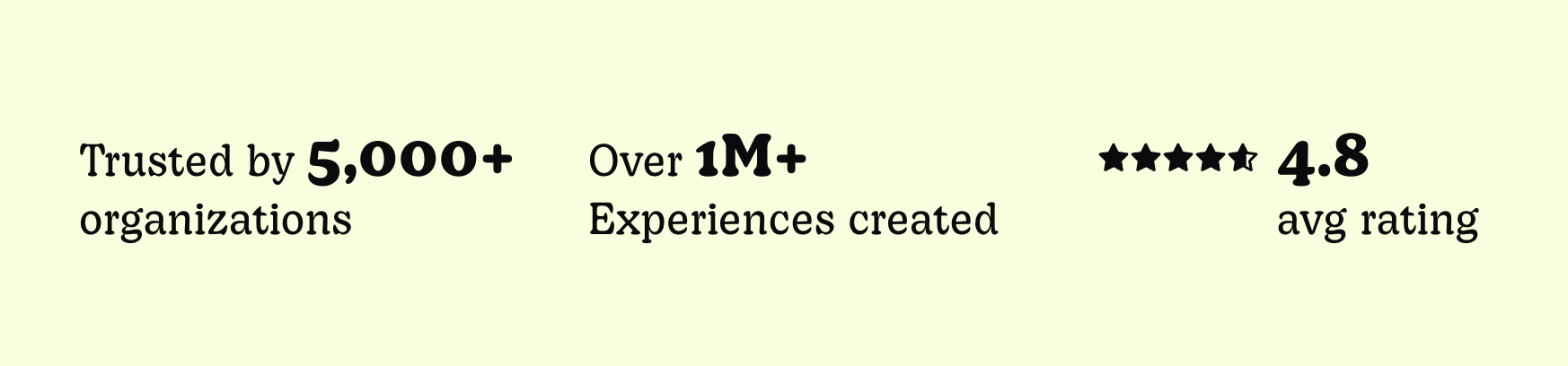
Goosechase has been around for more than 15 years. It's been used by thousands of organizations, including public school districts, universities, nonprofits, government agencies, tourism operators, and global brands. Over 1 million Experiences have been created on the platform. It maintains 99.9% uptime, holds a 4.8 App Store rating from more than 13,000 reviews, and continues to ship product updates regularly.
PlayTours is a younger platform, in market for about 5 years, with roughly 6,000 games run to date. That's a respectable start, and the team has built genuinely useful features. But for organizations evaluating platforms based on long-term reliability, depth of customer base, and proven scale, the gap is meaningful.
This is the kind of difference that tends to show up in the moments that matter most: when something breaks during your event, when you need to scale to thousands of participants, when you're running the same program for the third year in a row.
Advantage: Goosechase by a wide margin for organizations that need a platform they can rely on long-term.
Ease of Setup and Launch
Getting an experience off the ground should be straightforward, especially for first-time creators.
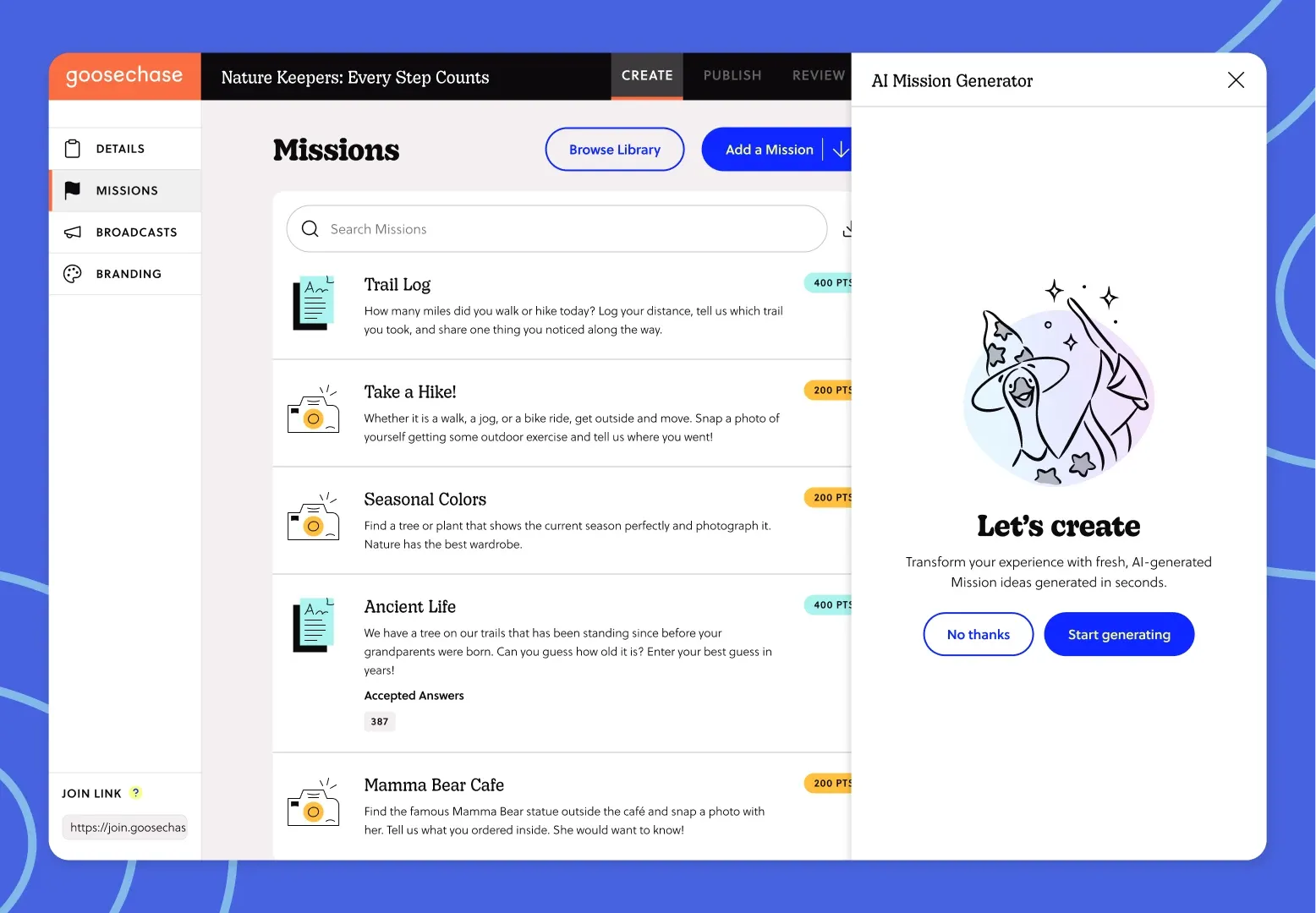
Goosechase Studio is a no-code desktop experience builder with a library of 250+ ready-to-go templates and an AI Mission generator that creates ready-to-use Missions. Describe the kind of Mission you want and the AI generates the challenge, prompt, and instructions for you. Combined with the templates library, this means most organizers can build a polished, customized Experience without facing a blank page. Goosechase also lets you build and test for free, so you can refine your Experience before it goes live.
PlayTours offers a drag-and-drop builder and supports unlimited free build and test time. PlayTours+AI is an in-builder text helper that can generate or improve copy in individual fields based on tone, audience, and language settings. It's similar in spirit to Goosechase's AI Mission generator, but Goosechase generates full Missions ready to drop into your Experience, while PlayTours' AI generates or refines copy within fields you've already structured. PlayTours doesn't offer templates either; new accounts get demo games to illustrate how the builder works. This means more creative lifting upfront if you're new to the platform.
Advantage: Goosechase for organizers who want a faster path from idea to launch, especially with templates plus AI that generates complete Missions.
Engagement Quality and Real-Time Energy
One of the clearest differentiators between the two platforms is how they create in-the-moment engagement.
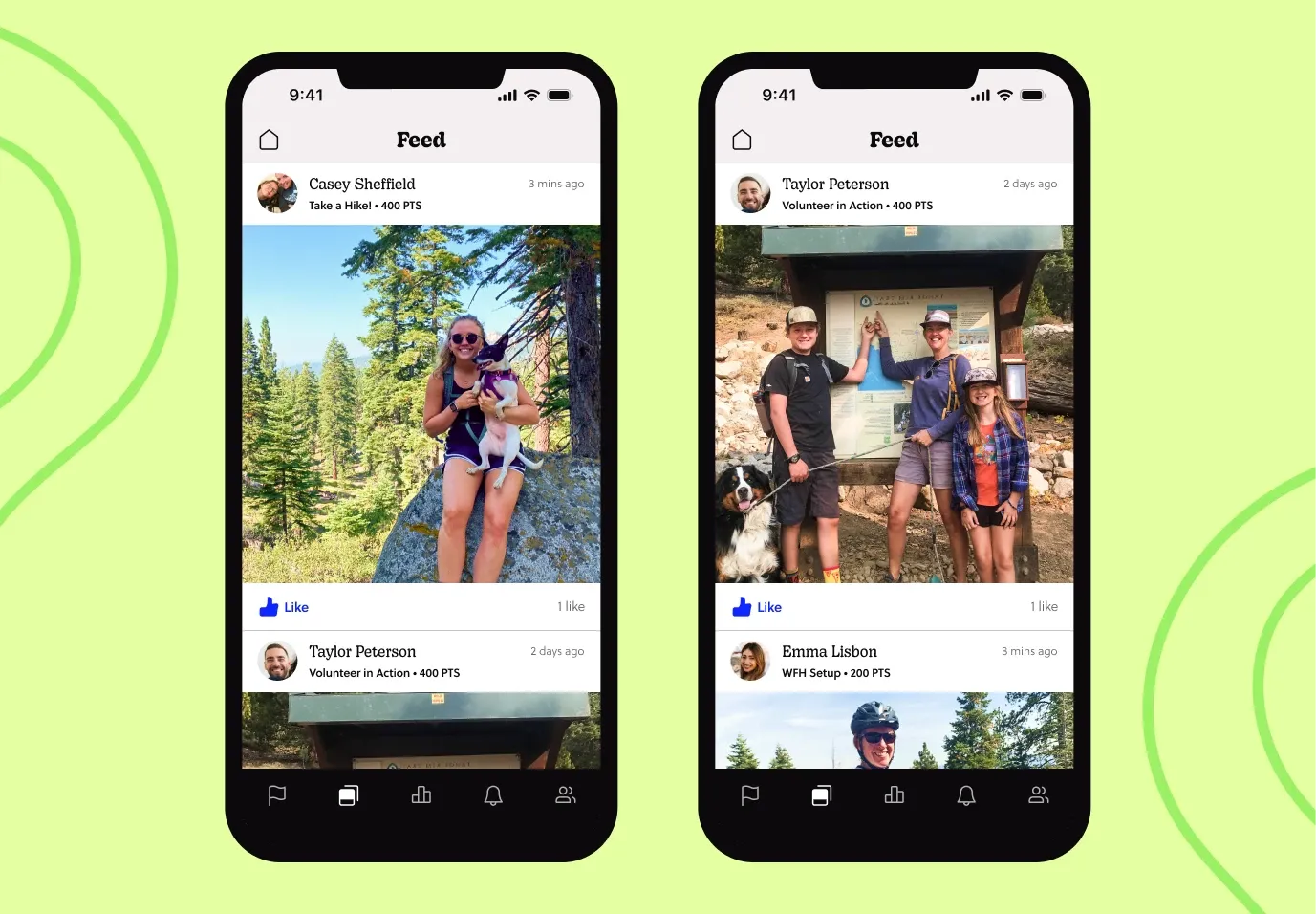
Goosechase includes a live activity feed so participants can see submissions from other teams as they come in. Combined with a live leaderboard, this creates a sense of community and momentum that keeps people engaged throughout the experience rather than just at the beginning and end. For events where you want energy to build as the experience progresses, this is meaningful.
PlayTours has a live leaderboard but does not appear to offer a live activity feed in the same way. The experience is more task-completion-focused, which works well for self-paced or guided tour formats but may feel less dynamic in competitive, group-energy-driven settings.
Advantage: Goosechase for experiences where real-time social energy matters. PlayTours for self-paced formats where participants move at their own speed.
Customization and Flexibility
Both platforms offer meaningful customization, but in different directions.
Goosechase lets you create experiences with diverse Mission types (photo, video, GPS, text, gated Missions that unlock subsequent challenges), links to external content, custom terms and conditions, and full control over experience structure and flow. The platform is flexible across a wide range of use cases without requiring technical skill. Goosechase also supports one team using multiple devices, so groups can play together from different phones or tablets.
PlayTours leans into deep game logic, with support for embedding external content (Google Docs, virtual tours, crossword puzzles), location-based stations, and hint purchasing. For facilitators who want to build complex, layered puzzle experiences or self-guided walking tours that move people through a defined route, this extensibility is a real strength.
Advantage: A matter of fit. Goosechase for organizations that want consistent engagement across a range of event types. PlayTours for facilitators building puzzle-driven walking tours and structured route experiences.
Reporting and Analytics
Both platforms now offer reporting, but they measure different things, which reflects how each platform thinks about success.
Goosechase reporting and analytics center on engagement: participation rates, submission history, photo and video content created by teams, and overall activity over the course of the experience. This is the data HR teams use to document program participation, educators use to assess student engagement, and nonprofits use to report on event impact and outcomes to stakeholders.
PlayTours analytics focus on task completion mechanics: team count, player count, session completion rate, average time to complete, hint usage, incorrect attempts, and skips. For facilitators tuning the difficulty of a puzzle game or measuring how teams moved through a structured route, that's useful operational data.
The difference matters. If your goal is to demonstrate the impact of an engagement program, you want a tool that surfaces what participants actually did and created. If your goal is to optimize the difficulty curve of a puzzle game or walking tour, completion mechanics will tell you what you need to know.
Advantage: Depends on your use case. Goosechase for engagement-driven reporting in HR, education, nonprofit, tourism, and community contexts. PlayTours for facilitators measuring task-level completion mechanics.
Security, Privacy, and Compliance
For organizations in education, HR, or enterprise settings, data security is not optional.
Goosechase offers education-grade privacy and security, dedicated K-12 plans, SSO support, custom terms and conditions, and is GDPR compliant. These are designed specifically for organizations that need to meet institutional or compliance requirements. Goosechase also runs on infrastructure with 99.9% platform uptime.
PlayTours states it is GDPR compliant. It does not appear to offer dedicated K-12 privacy controls, SSO, or custom terms and conditions.
Advantage: Goosechase for K-12 schools, enterprise HR teams, and organizations with institutional compliance requirements.
Real Examples
The best way to understand a platform's fit is to see what people actually build with it. Here are four Goosechase Experiences that show the range:
Climate Action through Play in NYC

Holes in the Wall Collective ran a series of Goosechase Experiences during Climate Week NYC to engage everyday New Yorkers in climate action across all five boroughs. Missions included writing love letters to the Department of Environmental Protection and sharing short videos of favorite NYC waterways. The Goosechase activity feed filled up with creative, heartfelt submissions, and winners reported visiting boroughs and neighborhoods they'd never been to before.
Read the full case study →
A 300-Guest Customer Appreciation Event

Infinity Medspa in Charlotte, NC ran their annual Beautypalooza event using Goosechase, with 300+ guests, 150+ teams, and Mission completion rates of nearly 70%. After comparing other platforms that required subscriptions, they chose Goosechase specifically because they could purchase a single Experience for their annual event. Missions doubled as marketing touchpoints (e.g., "Visit Room 1 to learn about microneedling and enter the secret code"), and the live leaderboard kept guests engaged throughout the night.
Read the full case study →
A Year-Round Outdoor Engagement Campaign
The Forest Preserve District of Will County built the Take It Outside Challenge (now Be a Trailblazer) on Goosechase to drive community engagement across 23,000 acres of preserved land. In its first year, the Experience drew more than 1,200 participants and over 117,000 submissions. The campaign has since matured into a year-round program with 2,000+ participants, an 80%+ participation rate, gated Missions, and $16,000+ in annual community-sourced prizes.
Read the full case study →
A 1,300-Mile Interactive Motorcycle Tour Across Mexico

The Mezcal Moto Rally takes a close-knit group of motorcycle riders from Texas to Mexico's mezcal-producing states each year, covering 1,300 miles over multiple days of riding, mezcal palenque visits, taco stops, and volcano climbs. Before Goosechase, organizers managed photo submissions, location updates, and cultural challenges through WhatsApp threads, tracking everything by hand alongside 8–10 hours of daily riding. With Goosechase, riders get the day's Missions in-app, submit photos and videos directly, watch a live leaderboard, and the organizers save hours of admin work. The submissions even feed the rally's annual documentary. The organizers describe Goosechase as "user-friendly, engaging, and contemporary. It makes our lives much easier as organizers, and racers love it."
Read the full case study →
These Experiences span community organizing, small business events, government-led engagement campaigns, and multi-day cultural tours. They show what's possible when an experience platform is flexible enough to adapt to your goals and reliable enough to run the same program year after year. Want to see it for yourself? Here are four ways to try it.
Pros and Cons
Goosechase
Pros:
- 15+ years in market, with thousands of customers and over 1 million Experiences created
- AI Mission generator that creates ready-to-use Missions, plus 250+ templates for fast creation
- Live activity feed creates real-time social energy
- Built-in engagement and submission reporting
- QR code joining for fast participant access
- Purpose-built K-12 plans with education-grade privacy and SSO
- Custom terms and conditions for public-facing events
- Subscription plans and single-Experience options for pricing flexibility
- 99.9% platform uptime and a 4.8 App Store rating from 13,000+ reviews
Cons:
- Highly bespoke puzzle-logic or embed-heavy experiences may require more configuration
- Some features, like advanced reporting, may feel like more than a small one-off event needs
PlayTours
Pros:
- Built specifically for self-guided walking tours and structured puzzle routes
- Flexible game logic with support for embedded external content (Google Docs, virtual tours, crossword puzzles)
- Task-level completion analytics (attempts, skips, hint usage) for facilitators tuning puzzle difficulty
- AI text helper for generating or refining mission copy
Cons:
- Younger platform (~5 years in market) with a smaller customer base and only ~6,000 games run to date
- No live activity feed
- No templates library (demo games only)
- No dedicated K-12 plans, SSO, or custom terms and conditions
Pricing Breakdown
Goosechase
- Free plan: Up to 3 participants (5 teams for K-12 educators)
- Single Experience plans: Start at $99 per Experience
- Subscription plans: Available for creators running multiple Experiences throughout the year
- K-12 plans: Starting at $99/year
Goosechase offers two pricing approaches: single Experiences and subscriptions. If you run an occasional one-off event, the single Experience option keeps costs tied to actual usage. If you run multiple Experiences a year, a subscription often delivers better value. Steep discounts are offered for schools and nonprofits.
PlayTours
- Free plan: Up to 2 active devices (teams) at a time
- $35/month: Up to 5 active devices, 20 total devices per month
- $79/month: Up to 60 active devices, 100 total devices per month
- $159/month: Up to 120 active devices, unlimited total devices per month
PlayTours prices by active device, where one "device" equals one piece of hardware regardless of how many people share it. Understanding what your actual device count will be is important when estimating costs, especially since the jump from the $79 tier to the $159 tier is significant.
Pricing note: Pricing is based on publicly available information as of May 2026 and is subject to change.
Final Verdict
Best for organizations, schools, and nonprofits: Goosechase. If you need a platform with a proven track record, purpose-built educational plans, real-time participant energy, and the templates and tools to get started quickly, Goosechase is the stronger fit.
Best for tourism (parks, ski resorts, museums, attractions): Goosechase. For tourism organizations that want visitors to engage interactively, share photos and videos, and create content as they explore, Goosechase delivers the engagement-driven format that fits the way visitors actually experience these places.
Best for one-off self-guided walking tours and puzzle-route experiences: PlayTours. For builders creating a single, structured walking tour or escape-room-style adventure where participants follow a defined route and solve location-based puzzles to unlock each stop, PlayTours is built around exactly that format. For tour operators, parks, museums, and attractions running ongoing or repeatable tour programs, Goosechase remains the stronger fit.
Best for one-off events with flexible pricing: Goosechase. The ability to purchase a single Experience without committing to a yearly subscription was the deciding factor for organizations like Infinity Medspa that only run a few events a year.
Best for enterprise and institutional compliance: Goosechase. For teams that need SSO, education-grade privacy, custom terms and conditions, reliable reporting, and a platform with 15+ years of track record, Goosechase is the more complete solution.
The honest summary: if you care about long-term platform reliability, broad customer adoption, and a track record of supporting real-world programs at scale, Goosechase is the safer and stronger choice, even for tour-style experiences. If you're specifically building a one-off self-guided walking tour or puzzle-route experience where reliability and repeatability aren't critical, PlayTours is purpose-built for that format and worth a look. Comparing other platforms? See how Goosechase stacks up against Scavify, Eventzee, and Let's Roam.
Ready to see how Goosechase fits your next event or program?
Start for free and build your first Experience in minutes.
FAQ
What is the main difference between Goosechase and PlayTours? Goosechase is an established interactive experience platform with 15+ years in market, thousands of customers, an AI Mission generator, 250+ templates, a live activity feed, and dedicated plans for K-12, nonprofits, tourism, and organizations of all sizes. PlayTours is a younger platform (about 5 years in market, ~6,000 games run to date) focused on self-guided walking tours, puzzle-route experiences, and games with location-based logic.
Do both platforms have AI features? Yes, but they work a little differently. Goosechase's AI Mission generator creates full Missions for you so you can drop them straight into your Experience. PlayTours' AI is a text helper that generates or refines copy in individual fields once you've designed the structure of the game. Both speed up creation; Goosechase's tool is built around producing ready-to-use Missions specifically.
Do both platforms offer reporting? Yes, but they measure different things. Goosechase reporting focuses on engagement: participation rates, submissions, and the photo and video content participants created. PlayTours analytics focus on task completion mechanics: attempts, skips, hint usage, and time to complete. Choose based on whether you're documenting engagement outcomes or tuning puzzle difficulty.
Which platform has a longer track record? Goosechase. It's been in market for more than 15 years, with thousands of customers and over 1 million Experiences created, including programs at major school districts, universities, nonprofits, tourism organizations, and global brands. PlayTours has been around for about 5 years, with approximately 6,000 games run to date.
Which platform is better for tourism, parks, ski resorts, and museums? Goosechase. Tourism organizations like parks, ski resorts, museums, and attractions use Goosechase to drive visitor engagement, capture photo and video content from visitors, and run repeatable seasonal programs. The format is interactive and engagement-driven rather than a fixed puzzle route. PlayTours is a viable choice specifically for one-off self-guided walking tours where participants follow a defined route and solve location-based puzzles to unlock each next stop, and where long-term reliability isn't a priority.
Which platform is better for schools and educators? Goosechase. It has dedicated K-12 plans, education-grade privacy and security, and SSO support.
Which platform is better for team building? Both platforms support team building. Goosechase's live activity feed, photo and video Missions, AI Mission generator, real-time leaderboard, and longer track record tend to create higher participant energy and lower platform risk in group settings. PlayTours is an option for facilitators whose priority is complex game logic over participant engagement.
How does Goosechase pricing work compared to PlayTours? Goosechase offers free, single-Experience, and subscription plans, with paid options starting at $99. PlayTours charges monthly based on active device count, starting at $35/month for up to 5 active devices. The right model depends on your event frequency and group size.
Can I try Goosechase for free? Yes. Goosechase's free plan supports up to 3 participants (5 for K-12 educators).
Is PlayTours free to use? PlayTours offers an unlimited free trial to build and test. A paid plan is required when running events with more than 2 active devices.
What kinds of events work best on Goosechase? Goosechase is designed to be flexible. Real-world examples include community engagement campaigns (Climate Week NYC with Holes in the Wall Collective), customer appreciation events (Infinity Medspa's Beautypalooza), and year-round outdoor engagement programs (Forest Preserve District of Will County's Take It Outside Challenge).
Competitor pricing and feature information based on publicly available data as of May 2026 and subject to change. Third-party trademarks belong to their respective owners.