Goosechase vs Scavify: Which Scavenger Hunt Platform Is Right for You?
If you're comparing Goosechase and Scavify, you're trying to solve the same core problem: how do you get people genuinely engaged, not just present, not just glancing at their phones, but actually participating?
Both platforms draw inspiration from the scavenger hunt format. Both are mobile-first. Both are used by organizations that want to make their events, programs, or team activities more interactive. The question isn't really which one works. It's which one works better for what you're trying to do.
This post gives you an honest, side-by-side look at both platforms across the factors that actually matter when you're making this call.
TL;DR
Choose Goosechase if you want a platform that consistently delivers a great participant experience across every device, gives you the flexibility to run everything from a simple team event to a large-scale public activation, and lets you build a full Experience in minutes with a built-in AI mission generator.
With a 4.8 App Store rating from more than 13,000 reviews, 99.9% uptime, and customers ranging from public school districts to PBS and NASA, Goosechase has a proven track record at scale, backed by over 15 years in the market.
Consider Scavify if your needs are simple, your audience is small, and you don't require advanced features like gated missions, SSO, custom terms and conditions, or AI-assisted creation.
Quick Comparison Table
| Goosechase | Scavify | |
|---|---|---|
| Best for | Teams, enterprises, events, nonprofits, higher ed | Smaller programs and basic engagement use cases |
| Participation design | Mission-based Experiences | Task-based Programs and Hunts |
| Device consistency | Consistent across iOS and Android | Varies by device |
| App update frequency | Regularly updated | No update to iOS app in 3+ years |
| Gated missions | Yes | No |
| AI mission generation | Yes | No |
| Participant join flow | Join codes, links, and QR codes | App download + name search required |
| SSO | Yes | No |
| Custom T&Cs | Yes | No |
| Starting price | $99 | $445 |
| App Store rating | 4.8 from 13,000+ reviews | 4.8 from ~1,000 reviews |
| Browser Based Play | Yes | Yes |
Who Each Product Is Best For
Goosechase is the stronger fit if you're:
- Running experiences where participation rate is a primary success metric
- Managing a team event, orientation, fundraiser, training program, or large-scale public activation
- Working across a distributed or hybrid group where consistent experience across devices matters
- Looking for a platform you can grow with and rely on long term
- Creating experiences that benefit from progressive disclosure, revealing missions one at a time as participants complete earlier ones
- Operating at scale and needing things like SSO, custom terms and conditions, or AI-assisted content creation
Scavify may work for you if you're:
- Running a simple, one-off activity with a small, tech-savvy group
- Not reliant on advanced features like gated missions or flexible join options
- Working in an environment where basic task completion is the full scope of what's needed
Deep Dive by Decision Factors
AI-Assisted Creation
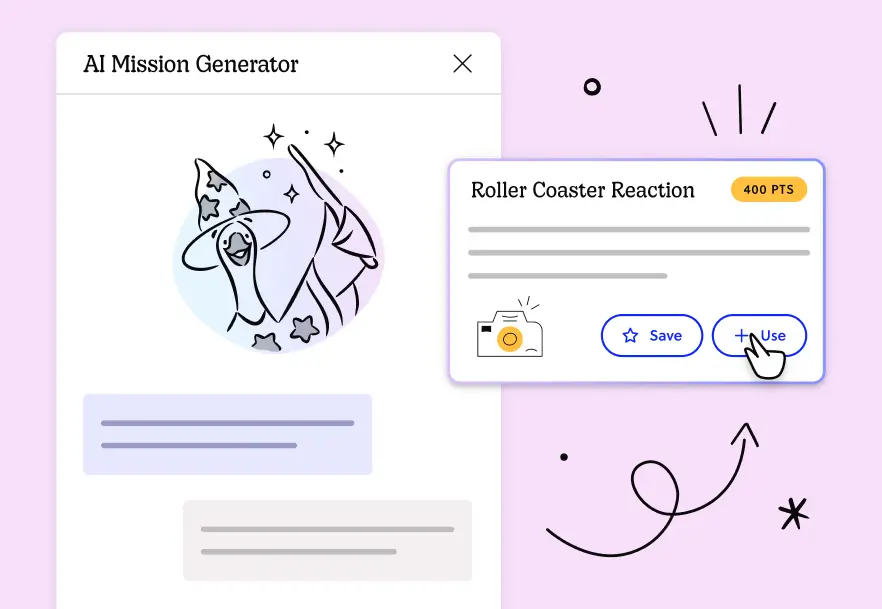
With a built-in AI mission generator, Goosechase makes it fast and straightforward to build a full Experience from scratch. Describe your audience and your goal, and you'll have a ready-to-run Mission list in minutes. For anyone who has stared at a blank page wondering where to start, it changes the creation process entirely.
Scavify offers no equivalent. For teams that want to launch quickly, iterate across multiple programs, or simply remove the guesswork from experience design, this is one of the most practical reasons to choose Goosechase over Scavify.
Participation Design: Missions vs Tasks
The language a platform uses reflects the experience it's designed to create. Goosechase uses the term Missions for the challenges participants complete and calls the overall event an Experience. Scavify uses Task Lists and refers to events as Programs or Hunts.
That's not just a naming convention. Goosechase is built from the ground up around active participation, and that philosophy carries through everything: the energy of the branding, the way the platform feels when you open it, and the way submissions land when they come in. Missions feel like something to chase. Tasks feel like something to check off.
When people show up to a Goosechase-powered event, the platform itself signals that something enjoyable is about to happen. Creators regularly choose Goosechase in part because they want their participants to feel that from the moment they join the Experience. If participation is what you're optimizing for, the platform built around that mindset gives you a meaningful edge.
Product Investment and Reliability
This is one of the sharpest differences between the two platforms. Goosechase invests continuously in its product. The team regularly ships updates to the app and the creator studio, incorporates customer feedback, and maintains a reliable and polished experience for both creators and participants. With 99.9% uptime and over 15 years in market, it's a platform organizations can build recurring programs around with confidence.
Scavify hasn't updated its iOS app in over three years, at the time of writing this.
For any organization running experiences that matter, whether it's an annual team event, a client-facing activation, or a fundraiser with real stakes, platform reliability and active development are table stakes. A tool that isn't being maintained is a tool that's falling behind.
Goosechase's 4.8 App Store rating comes from more than 13,000 reviews. Scavify's 4.8 comes from approximately 1,000. That's not a knock on Scavify's rating. It's a meaningful signal of scale, adoption, and sustained quality over time.
Gated Missions
If you've ever run a real scavenger hunt, you know that controlling the flow matters. The ability to unlock missions progressively, so that completing one challenge reveals the next, is what creates momentum, narrative, and genuine engagement.
Goosechase supports gated missions. Scavify does not.
For experience designers who want to guide participants through a structured journey, or creators who want to prevent people from skipping ahead and missing the point, this is a meaningful capability gap. It also separates a well-designed experience from a simple checklist.
How Participants Join
Getting participants into the experience should be the easiest part. Goosechase offers join codes, join links, and QR codes, giving creators multiple ways to get people in with as little friction as possible. Someone can scan a QR code at the door and be inside the experience within seconds.
With Scavify, participants must first download the app and then search for their program by name. That added friction at the most critical moment in the participant journey could meaningfully affect participation rates, especially for large or public-facing events.

SSO and Enterprise Access
For enterprise teams and larger organizations, Single Sign-On (SSO) is often a requirement for IT approval and broad adoption. Goosechase offers SSO. Scavify does not.
This makes Goosechase significantly easier to deploy and adopt at scale within organizations that have existing identity management systems.
Custom Terms and Conditions
For creators running large-scale public events, festivals, or community activations, the ability to set custom terms and conditions on your experience is an important legal and operational consideration. It's how you ensure you have the appropriate rights to participant submissions, photos, videos, and other content that may be used in marketing or shared publicly.
Goosechase supports custom terms and conditions. Scavify does not.
This may not matter for an internal team event, but for any public-facing activation where participant-generated content is part of the value, it's a feature worth taking seriously.
Device Consistency
Goosechase delivers a consistent experience whether your participants are on iOS or Android. That matters a lot when you're running an event for hundreds of people and can't predict what devices they'll bring.
Scavify's participant experience varies depending on the device being used. For smaller, controlled environments this may be manageable. But for any event where you can't control participant device type, a corporate all-hands, a community fundraiser, a university orientation, inconsistency in the participant experience is a real risk to engagement and completion rates.
Real Examples and Use Cases
The best way to understand what a platform can do is to see it in action.
PBS: Turning Fundraising Into Interactive Play
PBS Senior Director of Digital Fundraising Strategy Jen Newmeyer wanted to bring a new kind of energy to the pledge experience. After running several Goosechase experiments, her team found the format that worked: an interactive activation built around the PBS Books Readers Club community, timed intentionally outside of peak pledge periods and aimed at an already-engaged audience.
"In digital fundraising, attention doesn't just happen. It takes intentional strategy to capture and keep audiences engaged," says Jen Newmeyer, PBS. Goosechase gave her team the tool to deliver that strategy in a format that felt playful rather than transactional.
Forest Preserve District of Will County: 1,200 Participants, 117,000 Submissions
The Forest Preserve District of Will County wanted to get more people out exploring their 23,000 acres of preserved land. Their Goosechase-powered Take It Outside Challenge drew more than 1,200 participants who submitted over 117,000 nature-themed entries including GPS check-ins, wildlife photos, and trivia responses.
The impact went beyond the numbers. Digital Communications Manager Chad Merda described the experience as transformational for many participants, with stories of personal discovery and connection pouring in throughout the year.
Read the full Forest Preserve District case study.
Clint Independent School District: 600+ Educators, 14 Campuses, One Unforgettable Rally

Obed Hernandez Noris, Instructional Technology Coordinator at Clint ISD in El Paso, Texas, wanted to kick off the school year differently. His goal: bring over 600 staff members from 14 campuses together in a way that sparked real connection.
He ran a district-wide Goosechase experience as part of the annual Back to School Rally. Educators completed Missions like Principal Pep Talks and a Guess the Throwback baby photo challenge. The result wasn't just smiles during the event. As one teacher noted: "They didn't just meet new colleagues — they made memories."
This is exactly the kind of experience that a task-list format struggles to replicate. The Missions created moments, not checkboxes.
Read the full Clint ISD case study.
University of Calgary: Alumni Engagement, Three Summers Running

The University of Calgary's Office of Development and Alumni faced a familiar challenge: how do you keep alumni engaged during the summer when everyone scatters? Traditional programming like webinars and social content wasn't cutting it.
They turned to Goosechase and ran a virtual alumni scavenger hunt that drew participants from across the country. The experience ran for three consecutive summers and became one of their most anticipated annual programs, building nostalgia, community, and awareness of alumni perks in a format people actually wanted to take part in.
Read the full University of Calgary case study.
These are the kinds of outcomes you get when participation is built into the platform's DNA, not bolted on as a feature. Want to see it for yourself? Here are four ways to try it.
Pros and Cons
Goosechase
Pros:
- Built-in AI mission generator speeds up creation
- Consistent participant experience across all devices
- Actively developed and regularly updated
- 99.9% uptime and 15+ years in market
- Gated missions for structured, progressive experiences
- Multiple participant join options (codes, links, QR codes) that minimize friction
- SSO support for enterprise adoption
- Custom terms and conditions for public or rights-sensitive events
- 4.8 App Store rating from 13,000+ reviews
- Free to use for up to 3 participants. After that, paid plans start at $99
Cons:
- Broader feature set may feel like more than needed for very simple, one-off use cases
- As with any platform, the quality of the experience depends on how thoughtfully the creator designs the Missions
Scavify
Pros:
- Familiar task-based format for simple, low-complexity use cases
- 4.8 App Store rating within its review pool
Cons:
- Inconsistent participant experience across iOS and Android
- No iOS app updates in 3+ years raises questions about long-term product investment
- No gated missions limits experience design options
- Participant join flow adds friction
- No AI creation tools
- No SSO
- No custom terms and conditions
- Starts at $445
Pricing Breakdown
Goosechase is free to get started. You can run an Experience for up to 3 participants at no cost, which means you can explore the platform, build your first Experience, and see how your participants respond before spending anything.
Paid plans start at $99 per Experience. For K-12 educators, there's a dedicated plan at $99 per year, making it one of the most accessible options available for schools that want to run experiences consistently throughout the year.
Scavify also offers a free trial, and then plans start at $445.
That's a meaningful difference, particularly for smaller teams, nonprofits, schools, or anyone running a single event who wants to try the format before committing to a larger program. Goosechase offers per-Experience pricing, which means you're paying for what you actually run, with no pressure to over-commit upfront.
For organizations that do plan to run experiences regularly, it's worth doing the math on volume. But for most buyers evaluating these two platforms side by side, Goosechase's entry point is significantly lower, and it comes with a more actively developed product, broader feature set, and more flexible participant join options than Scavify offers at any price point.
Final Verdict
Best for enterprise and HR teams: Goosechase. SSO, gated missions, consistent device experience, 99.9% uptime, and a platform that IT teams and employees can both rely on make it the clear fit.
Best for large-scale public events and festivals: Goosechase. Custom terms and conditions, multiple join pathways, and active product development make it the more reliable choice when the stakes are public-facing.
Best for higher ed and orientation: Goosechase. Cross-device consistency and the ability to structure participation progressively makes it well-suited for diverse, large incoming cohorts.
Best for K-12 educators and schools: Goosechase. A flexible platform that works across classroom activities, school-wide events, and staff days alike. The simple join flow means students spend time participating, not troubleshooting.
Best for nonprofits and community engagement: Goosechase. Repeatable experiences, low join friction, and a format that feels genuinely engaging rather than just task-based give it the edge for community activation.
Best for simple, low-complexity, one-off use cases: Either platform can work. If your group is small, devices are consistent, and you don't need progressive mission unlocking or advanced access features, Scavify's basic task approach may be sufficient.
The honest summary: if participation rates matter, if you're building something that will run more than once, or if you're working with any meaningful scale or complexity, Goosechase is the stronger, more reliably maintained platform. Comparing other platforms? See how Goosechase stacks up against Eventzee, PlayTours, and Let's Roam.
Experience is everything. Make sure the platform you choose is built to deliver it.
Frequently Asked Questions
Is Goosechase better than Scavify?
For most organizations, yes. Goosechase has been in market for over 15 years, maintains 99.9% uptime, holds a 4.8 App Store rating from more than 13,000 reviews, and offers a significantly broader feature set including gated missions, AI-assisted creation, SSO, and custom terms and conditions. It also starts at a lower price point. Scavify may be sufficient for very simple, small-scale use cases, but for anyone who cares about participation rates, experience design, or running programs more than once, Goosechase is the stronger platform.
How much does Goosechase cost compared to Scavify?
Both platforms offer free trials. Goosechase starts at $99. K-12 educators and NPOs can take advantage of significant discounts. Scavify starts at $445. For schools, nonprofits, and teams running single events, the difference is substantial.
Does Scavify have gated missions?
No. Scavify does not support gated missions, meaning participants can complete tasks in any order without unlocking new ones progressively. Goosechase does support gated missions, which is a key feature for creators who want to guide participants through a structured journey or build momentum across an experience.
Which scavenger hunt platform is better for large events?
Goosechase. For large events, consistent cross-device experience, flexible join options, custom terms and conditions for participant-generated content, SSO for organizational access, and 99.9% uptime all become important. Goosechase supports all of these. Scavify does not.
Is Goosechase good for schools and educators?
Yes, and it's priced specifically for them. Goosechase offers a K-12 educator plan at $99 per year, making it accessible for teachers and school staff who want to run experiences across multiple classes or school events throughout the year. The platform works across mobile devices, tablets, laptops, and chromebooks, keeps setup simple for teachers, and creates experiences that students actually enjoy participating in.
Competitor info based on publicly available data as of April 2026 and subject to change. Third-party trademarks belong to their respective owners.