Screens as Doorways: How Goosechase Bridges Tech-Native Learners and the Natural World
There is a moment I watch for in every workshop I facilitate. A teacher—seasoned, skeptical, probably wondering how this activity is going to be any different from the last edtech pitch they sat through—pulls out their phone, opens Goosechase, and gets assigned their first mission: "Find something outside that looks dead but isn't. Photograph it and explain how you know it's alive."
They hesitate. Then they walk outside.
Ten minutes later, they're crouched over a patch of moss on a concrete step, debating with a colleague whether dormant seeds qualify. And I know—it's working.
I am a teacher educator at the University of Michigan, and my work sits at what has become an increasingly urgent intersection: mobile technology and place-based science learning. The question I keep returning to—in graduate seminars, in middle school classrooms, and in professional development workshops for practicing teachers—is deceptively simple: How do we use the tools students already love to help them fall in love with the world right outside their door?
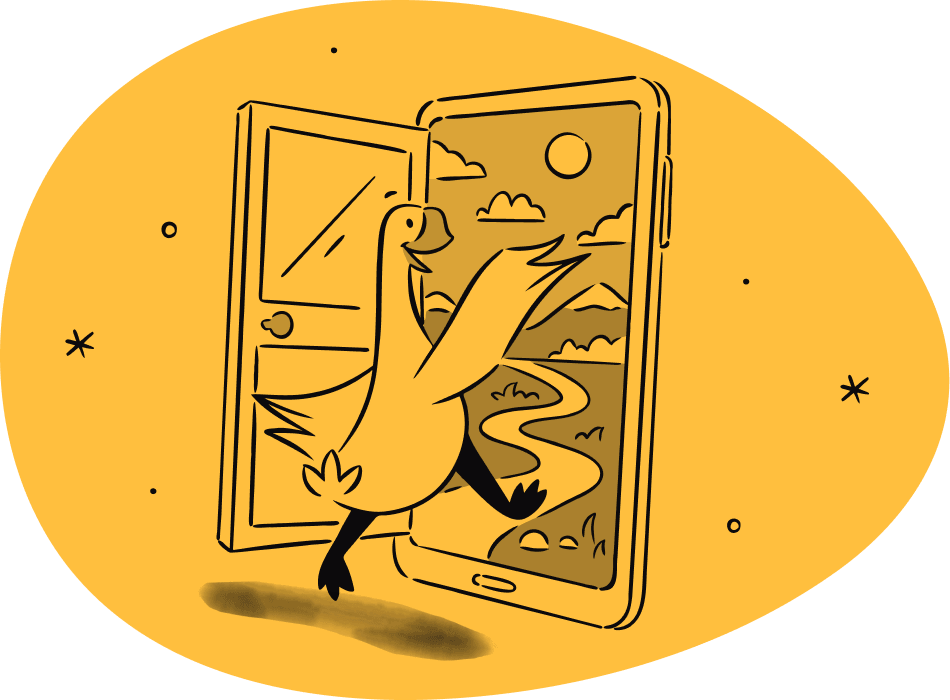
Goosechase, I've come to believe, is one of the most powerful answers to that question I've found. Not because it's flashy or gamified (though teachers and students respond to those features). But because of what it does at a deeper pedagogical level: it turns screens into doorways.
The Problem Worth Naming
Today's students are, in many ways, the most connected generation in history—connected to content, to peers, to global information streams available in seconds. And yet, a growing body of research describes a parallel disconnection: from the natural world, from their local communities, from the very places in which they live.
Richard Louv named this phenomenon nature-deficit disorder—not a medical diagnosis, but a cultural one. The idea that as screens multiply, unstructured time outdoors diminishes, and with it, children's capacity to observe, wonder, and feel at home in the natural world. As an educator, I see this play out in real time. I have watched eighth graders stand next to a creek they pass every single day and genuinely not know what to look at. I have watched pre-service teachers struggle to design outdoor learning experiences because they themselves feel uncertain in unstructured natural environments.
The conventional response to this problem is to put the screens away. Close the laptops, pocket the phones, and go outside. I understand the impulse. But I've come to think that framing sets up a false binary—and for today's students, it often doesn't work. When we ask tech-native learners to abruptly abandon their digital fluency at the classroom door, we lose them before we've even begun.
What if, instead, we met students where they are? What if technology itself could serve as the bridge—not the destination, but the doorway?
Starting with Teachers: The PD Experience That Changed My Thinking
My clearest evidence for this framework didn't come from students first. It came from teachers.
When I began facilitating professional development workshops using Goosechase, I had a hypothesis but not yet proof. I suspected that if I could help teachers experience the platform the way their students would—as participants in a well-designed mission sequence, not just observers of a slideshow—something would shift. I was right, but not in the way I expected.
The shift wasn't primarily technological. Teachers didn't leave saying, "I can't wait to use this app." They left saying things like, "I noticed the lichen on the north side of every tree trunk—how did I never see that before?" and "I kept wanting to ask questions about what I was finding. That's the feeling I want my students to have."
That's the pedagogical sleight of hand embedded in a well-designed Goosechase experience: while participants are focused on earning points and completing missions, their attention is being carefully directed toward the world around them. The app becomes, quite literally, a lens—something to look through, not at.
"I kept wanting to ask questions about what I was finding. That's the feeling I want my students to have." — Workshop participant, science educator
For teachers who feel uncertain about leading outdoor science experiences, this matters enormously. One of the most consistent barriers to place-based learning is teacher confidence—not in content knowledge, but in structured unstructuredness. What do I do when a student asks about something I don't know? How do I manage 28 kids outside without a worksheet telling them exactly what to find? Goosechase addresses both anxieties simultaneously. The mission structure provides scaffolding and focus without prescribing answers, and the platform handles logistics—team management, photo collection, progress monitoring—so teachers can focus on the science conversations emerging around them.
By the end of a PD session, teachers aren't just learning a tool. They're experiencing what it feels like to be a curious, engaged learner in a place they'd previously ignored. That experience, I've found, is what actually transfers to their classroom practice.
Then the Students: When Technology Steps Aside
The teacher PD experience is the frame. The student experience is the picture inside it.
In my work with eighth graders on a water quality investigation, I watch the same sequence unfold every time, and it never loses its power. Students begin skeptical—"Is this like a scavenger hunt? That sounds kind of babyish." Then they receive their first mission. Then they go outside.
One mission type I return to consistently is what I call a phenomenon identification prompt: "Locate evidence that erosion is happening near our creek. Document it with a photo and identify at least two factors you think are contributing to it." This single mission does something no textbook exercise can replicate: it requires students to look at a specific, real place and apply scientific thinking to what they actually find there. Not a hypothetical watershed in a textbook diagram—theirs. The creek they walk past on the way to the bus.
The photo submission feature in Goosechase turns out to be pedagogically essential. When students have to photograph their evidence rather than just describe it, they look more carefully. They argue about framing ("that doesn't show the erosion, you need to back up"), about classification ("is that a human impact or natural erosion?"), about interpretation. These are exactly the epistemic moves we want science learners to make—and the device in their hand is prompting them.
The GPS check-in feature adds another layer. When students tag their observations with location data, a spatial dataset emerges that becomes the raw material for whole-class analysis. Back in the classroom, patterns appear: temperature correlates with shade coverage; macroinvertebrate diversity drops downstream from the road crossing. Suddenly the creek isn't just a creek—it's a system, and they've produced the evidence to understand it.
And then there's the moment I mentioned at the beginning of this piece. The moment that justifies all of it.
A student submitted a photo of the schoolyard creek at the end of one investigation with a handwritten caption in the text field: "There's a whole ecosystem here. I never noticed."
That's the moment technology steps aside. That's when the screen becomes a doorway, and wonder walks through it.
Why Goosechase Works: A Framework, Not Just a Feature List
I want to be precise about why I think this platform works, because I've tried other tools and not achieved the same results. It isn't the gamification alone—points and leaderboards can motivate students to do almost anything, including tasks with no learning value whatsoever. The power of Goosechase, as I've come to understand it, lies in four specific mechanisms that align with place-based education research.
It scaffolds observation without prescribing conclusions.
Well-designed missions focus student attention on specific phenomena without telling students what to think about what they find. The mission is a prompt for noticing, not a fill-in-the-blank exercise. This preserves the essential openness of scientific inquiry while preventing the aimless wandering that can make unstructured outdoor time feel overwhelming for both students and teachers.
It produces shareable artifacts from real places.
Every Goosechase submission is a digital artifact—a photo tied to a location, a video with a timestamp, a text response generated in the field. These artifacts become the curriculum. Rather than telling students about erosion, you project their photos of erosion they found, and the class analyzes the evidence together. Student discovery becomes the content.
It meets students inside their existing fluency.
Students don't experience Goosechase as "educational technology"—they experience it as a familiar, social, gamified interface. This matters because it removes the activation energy required to engage. They pick up the app with the same ease they pick up any other platform, and before they've decided whether they're "into" outdoor learning, they're already outside, already noticing, already hooked.
It lowers the barrier for teachers without lowering the ceiling.
A mission can be as simple as "Find five different leaf shapes" for a third-grade class or as complex as "Document microplastic pollution sources within 500 meters of school and propose a remediation plan" for high school environmental science. The platform is the same; the pedagogical sophistication is determined entirely by the mission design. This makes Goosechase accessible to teachers at any confidence level while remaining powerful enough for teachers who want to push deep.
A Note on Intentionality
I want to be careful here not to suggest that any use of Goosechase automatically produces meaningful learning. It doesn't. A poorly designed mission—"Find something green and photograph it"—is unlikely to do much beyond getting students briefly out of their seats. The platform is a vehicle; the mission design is the map.
The research on technology in outdoor education is instructive here. Studies consistently show that the right technology, used intentionally, can actually deepen engagement with place rather than diminish it. Students using mobile devices for structured outdoor inquiry spend more time observing their environment, notice details they would otherwise miss, and return to outdoor spaces voluntarily. The key word is intentionally. Technology must serve the learning goals, not substitute for them.
In my own practice, I think about mission design in terms of cognitive scaffolding: low-barrier opening missions that give every student an entry point ("Find something that doesn't belong here and explain why"), building toward more complex, systems-level thinking ("Trace one piece of litter to its likely source and describe the pathway it traveled to get here"). Point values signal what matters—I deliberately assign the highest points to missions that require interpretation and reflection, not just documentation. The leaderboard, in other words, rewards thinking.
The Doorway Is Open
I am not arguing that screens are neutral. They're not. Unstructured screen time has real costs, and the nature-deficit problem is real. But I am arguing that technology is not inherently opposed to wonder—and that for the generation growing up in a digital-first world, the path back to nature may run, at least partly, through the very devices we've been asking them to put away.
Goosechase, at its best, is a threshold. It uses the language students already speak—apps, points, photos, teams—to walk them toward something they didn't know they were missing: the experience of genuinely seeing the place they inhabit. The creek they walk past. The lichen on the concrete. The ecosystem hiding in a schoolyard crack.
That transition—from screen to stream, from interface to inquiry, from consumer to scientist—is what I believe makes this work worth doing. The screen is not the destination. It is, at its best, the doorway.
And in my experience, once students step through it, they want to keep going.